Soft, Ductile Materials
Soft, highly ductile metals that deform, smear, and embed abrasives during preparation. Careful technique (sharp abrasives, light pressure, thorough cleaning) is essential to reveal true microstructure.
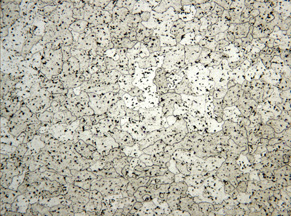
Overview
Most Class 1 materials fall below 150 HV, though certain alloys (beryllium copper, aluminum bronzes, manganese bronzes) exceed this in hardened tempers; they remain in Class 1 because their preparation behavior aligns with the group.
Preparation Challenges
Seven properties drive every choice in the prep procedure. Tap a card for the full reasoning.
Deformation & Smearing Plastic flow smears grain boundaries and second-phase particles.
Low hardness and high ductility cause material to plastically deform and smear over grain boundaries and second-phase particles during cutting, grinding, and polishing. Use sharp, fresh abrasives with light, consistent pressure and avoid excessive grinding steps to minimize subsurface damage.
Abrasive Embedding SiC and diamond particles lodge in soft surfaces and mimic inclusions.
Soft surfaces trap abrasive particles from SiC papers and diamond compounds, leaving permanent artifacts that can be mistaken for inclusions. Thorough ultrasonic cleaning between preparation steps is essential. Diamond grinding discs can reduce embedding compared to conventional SiC paper.
Work Hardening Cold-worked layer distorts etch response and apparent microstructure.
Many Class 1 materials, especially aluminum and copper alloys, work harden during preparation. This altered surface layer can affect etching response and may be mistaken for intentional heat treatment effects. Minimize deformation at each step and use a final vibratory polish to help remove the affected layer.
Relief & Edge Rounding Phases polish at different rates; nap clothes round edges.
Different phases and constituents polish at different rates, creating height differences that obscure fine microstructural features. Napped polishing cloths worsen relief and round specimen edges. Use napless or low-nap cloths and edge-retaining mounting compounds to maintain flatness.
Thermal Sensitivity Low melting points and age-hardened tempers can't take hot mounting.
Low melting points (lead, tin, zinc) and age-sensitivity (2xxx, 6xxx, 7xxx aluminum; beryllium copper) require careful temperature control. Compression mounting temperatures (150-180°C) can over-age precipitation-hardened alloys or deform low-melting materials. Use castable mounting for heat-sensitive specimens and ensure adequate coolant during sectioning.
Oxide & Surface Layer Preservation Anodized/corrosion layers need edge-retaining mounts.
When analyzing anodized layers, corrosion products, or surface treatments in cross-section, oxide layers must be preserved through careful sectioning away from the area of interest and edge-retaining mounting media. For standard bulk microstructure examination, this is not typically a concern.
Grain Boundary Revelation Residual damage blocks the etch; finish with colloidal silica or vibratory.
Residual deformation from over-grinding or aggressive polishing prevents grain boundaries from etching cleanly, even with the correct etchant. The deformation layer must be fully removed. A final polish with colloidal silica or a vibratory polishing step is often necessary before etching.
Class 1 Materials
Expand any group to view materials. Click a material name to open its dedicated prep procedure.
Aluminum Alloys
- 1100 Aluminum
- 2011 Aluminum
- 2017 Aluminum
- 2024 Aluminum
- 2024-T3 Aluminum
- 3003 Aluminum
- 3004 Aluminum
- 5052 Aluminum
- 5056 Aluminum
- 5083 Aluminum
- 5086 Aluminum
- 5454 Aluminum
- 5456 Aluminum
- 6005 Aluminum
- 6013 Aluminum
- 6061 Aluminum
- 6063 Aluminum
- 6082 Aluminum
- 7050 Aluminum
- 7075 Aluminum
- 7475 Aluminum
- A356 Cast Aluminum
- A380 Cast Aluminum
- AM AlSi10Mg (SLM)
Copper Alloys
- C11000 Electrolytic Tough Pitch Copper
- C17200 Beryllium Copperaged temper exceeds 150 HV; still Class 1 prep behavior
- C26000 Cartridge Brass
- C36000 Free-Cutting Brass
- C46400 Naval Brass
- C51000 Phosphor Bronze
- C63000 Aluminum Nickel Bronzehigher hardness in aged condition
- C71500 Cupronickel 70-30
- C86300 Manganese Bronzehigher hardness in as-cast condition
- C90700 Tin Bronze
- C93200 Leaded Tin Bronze
- C95400 Aluminum Bronzeheat-treated condition may exceed Class 1 range
Magnesium Alloys
- AM60 Magnesium
- AZ31 Magnesium
- AZ31B Magnesium
- AZ91 Magnesium
- WE43 Magnesium
Zinc Alloys
- Zamak 3
- Zamak 5
Lead & Tin
- Pure Lead
- Pure Tin
Solder Alloys
- Sn-37Pb Eutectic Solder
- SAC305 Lead-Free Solder
Bearing Alloys
- Babbitt Bearing Alloy
Precious Metals
- Pure Gold
- Pure Platinum
- Pure Silver
Polymer Matrix Composites
- Aramid Fiber Reinforced Polymer
- Carbon Fiber Reinforced Polymer (CFRP)
- Glass Fiber Reinforced Polymer (GFRP)
Recommended Procedure
Five-stage workflow. Each step shows the headline first. Expand for the full technical detail.
-
1
Sectioning
Low-speed abrasive cutting with continuous coolant; aluminum oxide blade for non-ferrous metals, diamond wafering for composites.
Safety: Magnesium alloys produce pyrophoric particles when sectioned dry. Always use water-based coolant; keep a Class D fire extinguisher accessible.
More detail
Use low-speed abrasive cutting with continuous coolant flow and minimal feed rate to limit subsurface damage. Aluminum oxide blades are typical for non-ferrous metals. For small or delicate samples, precision wafering with a diamond blade provides the cleanest cut. For polymer composites, use diamond wafering blades to prevent fiber pullout and delamination.
-
2
Mounting
Castable (cold) mounting preferred for heat-sensitive alloys and low-melting metals. Vacuum-impregnate porous composites.
More detail
Castable (cold) mounting is preferred for heat-sensitive alloys such as age-hardened aluminum, tempered beryllium copper, and low-melting-point metals (lead, tin, solder, babbitt). Compression mounting is acceptable for non-heat-sensitive materials. Use edge-retaining compounds when edge preservation matters. For porous polymer composites, vacuum impregnation with low-viscosity epoxy is essential to fill voids and prevent fiber pullout during grinding.
-
3
Grinding
For aluminum, start with 1200 grit ALO paper to avoid SiC embedding. For copper and other soft non-ferrous, start 240-320 grit SiC and step through 400 / 600 / 800 / 1200.
More detail
Aluminum (Don §11.1.1): Start with 1200 grit ALO paper (water, 5-10 lb, 100/100 rpm, until plane), then 800 grit (P2400) SiC paper and 1200 grit (P4000) SiC paper, 1 minute each. ALO paper at the plane-grinding step avoids the SiC embedding that is a primary concern for soft aluminum surfaces.
Copper and other soft non-ferrous: Start at 240-320 grit SiC and progress through 400, 600, 800, and 1200 grit. Use light, consistent pressure (5-10 lb / 22-45 N); heavy loads cause deformation that propagates into subsequent steps. Clean thoroughly between grits to prevent carryover. Diamond grinding discs are an alternative that reduces abrasive embedding.
-
4
Polishing
Aluminum and copper share the same rough polish: 1 µm DIAMAT on ATLANTIS. Final polish uses alumina on NAPPAD for routine work, or colloidal silica + chemical additive on MICROPAD for color etching / cold-worked Cu / Cu2O retention.
More detail
Aluminum (Don §11.1.1): A single 1 µm DIAMAT diamond step on ATLANTIS polishing pad with DIALUBE Purple Extender (5-10 lb, 100/100 rpm, 2 minutes) is sufficient when grinding finished at 1200 grit. Final polish with 0.05 µm Nanometer alumina on NAPPAD (5-10 lb, 100/100 rpm, 1 minute). Don §11.1.1 specifies alumina rather than colloidal silica for the final step; alumina preserves oxide inclusions at their true position rather than lifting them with the slight chemical attack of silica. For heat-treated and cast Al-Si alloys, insert an optional 3 µm DIAMAT on ATLANTIS step before the 1 µm polish.
Copper (Don §11.1.2): Same procedure through rough polish as aluminum: 1 µm DIAMAT on ATLANTIS (DIALUBE Purple Extender, 5-10 lb, 100/100 rpm, 2 minutes). The final polish has two paths chosen by the analytical goal:
- Standard final, 0.05 µm Nanometer alumina on NAPPAD (5-10 lb, 100/100 rpm, 1 minute): Routine grain size, twin density, phase ID, hardness testing, general microstructure documentation. Don's primary recipe.
- Advanced final, colloidal silica + chemical additive on MICROPAD (chemical-mechanical/attack polish): When prepping for color etching (Klemm's, Beraha's), for cold-worked pure Cu, for Tough-Pitch Cu2O retention, or for quantitative inclusion analysis. Additives: 1% ferric (III) nitrate for pure copper; 96 mL silica + 2 mL NH₄OH (25%) + 2 mL 3% H₂O₂ for alloys. Polish in 1-minute cycles with microscope inspection; switch to plain water for last 20-30 seconds.
Vibratory polishing (1-4 hours with colloidal silica) is an excellent optional supplement to either final-polish path when image-analysis-grade flatness is required.
-
5
Etching
Short immersion or swab. Precious metals use glycerol-modified aqua regia; silver tarnishes. Examine immediately.
More detail
Soft materials etch quickly. Start with short immersion times and increase as needed. Swab etching offers better control than immersion for many Class 1 materials. Verify that the deformation layer has been fully removed before etching; residual damage will obscure grain boundaries regardless of etchant selection.
Precious metals are the exception: gold and platinum are chemically inert; the standard metallographic etchants are dilute or glycerol-modified aqua regia (e.g., 8 HCl : 1 HNO₃ : 1 glycerol for controlled grain-boundary attack), with platinum often heated to 50-70°C; full-strength aqua regia dissolves these metals and is too aggressive for routine metallography. Silver responds to potassium dichromate or ferric chloride but tarnishes within minutes after etching and must be examined immediately.
Common etchants by family
- Aluminum alloys
- Keller's reagent (general); Barker's anodic (grain structure under polarized light); Tucker's (cast Al); Weck's tint etch
- Copper alloys
- 50% NH₄OH + 50% H₂O₂ (general); FeCl₃ in HCl (brasses/bronzes); Klemm's tint etch (phase ID); Beraha's sulfide
- Magnesium
- Acetic-picral (general); acetic glycol (AZ alloys); glycol etch (cast Mg)
- Zinc / Zamak
- Palmerton's reagent (CrO₃ in Na₂SO₄)
- Lead, Tin, Solder
- Glacial acetic + HNO₃ (lead/tin); 3 HCl : 1 HNO₃ + glycerol (solder); ammonium molybdate for grain contrast
- Babbitt bearing alloys
- 2% nital (Sb/Sn structure); FeCl₃ in HCl for tin-base; ammonium persulfate for lead-base
- Precious metals
- Au, Pt: glycerol-modified aqua regia (8 HCl : 1 HNO₃ : 1 glycerol). Ag: K₂Cr₂O₇ or FeCl₃; examine immediately (tarnish).
- Polymer matrix composites
- Typically not chemically etched. Use polarized or differential interference contrast; specialty stains (KMnO₄-based) for fiber/matrix contrast.
Aluminum etchant guide → Copper alloy etchant guide → Zinc etchant guide → Learn about etchants → Shop etchants →
Quality Checks
- No deformation visible under polarized light
- Grain boundaries etch clearly and uniformly
- Second-phase particles intact, not smeared
- No embedded abrasive particles on the polished surface
- Minimal relief between phases